+971 50 634 3878 Sharjah, Dubai info@lifeguarddatarecovery.com

How Long Does Professional Data Recovery Take in UAE?
When a major storage array crashes, a laptop refuses to boot, or important business files are accidentally deleted, time slows down. In the corporate hubs and creative studios across the UAE, the immediate question following data Lifeguard data Recovery loss isn’t just about cost it is “How quickly can I get my files back?”
The short answer is that recovery can take anywhere from a few hours to more than a week. Because data storage media is intricate, the true timeline depends heavily on whether your hardware is physically broken or suffering from a software-level glitch. Lifeguard Data Recovery
This guide provides a realistic, technically verified breakdown of turnaround times for professional data recovery services UAE, explaining where the time is spent and how to navigate a data crisis efficiently.
Data Recovery Turnaround Time UAE The 3 Main Service Tiers
Certified data recovery laboratories structure their operations into clear service tiers to accommodate both casual consumers and enterprise emergencies.
Standard Turnaround Times vs. Emergency Data Recovery UAE
A common point of confusion is why standard turnaround takes several days if the actual engineering work might only require a few hours. In a standard queue, your drive waits its turn behind existing cases already mounted on the diagnostic benches.
If you face catastrophic operational downtime, opting for emergency data recovery UAE shifts your device to the absolute front of the line. Under emergency protocols, a dedicated engineer works exclusively on your media
Why Does Professional Data Recovery Take Different Amounts of Time?
Data recovery is bounded by the laws of physics and data density. There are two primary variables that dictate how long a drive stays in the lab:
The Nature of the Damage (Logical vs. Physical): Logical issues (deleted files) mean the drive works perfectly, so extraction moves at maximum hardware speeds. Physical damage requires micro-surgery to make the drive functional before a single byte can be transferred.
The Capacity and Read-Speed of the Storage Media: Moving data off a damaged drive must be done at highly throttled, low-stress speeds to protect the fragile storage layers. Cloning a failing 12TB enterprise drive bit-by-bit simply takes vastly longer than scanning a 256GB microSD card.
How Long Does Hard Drive Data Recovery Take in UAE?
For standard mechanical hard disk drives (HDDs), a logical recovery typically wraps up within However, if the drive is clicking, buzzing, or completely unresponsive, physical recovery usually requires business days.
How Hard Drive PCB Failure Slows Down the Process
If a power surge hits your system, it often causes a hard drive PCB failure (Printed Circuit Board). While this sounds like a quick fix, modern hard drives embed unique calibration data known as adaptive ROM architecture directly onto that specific circuit board.
To recover your data, a laboratory technician cannot simply swap the board with an identical model. They must carefully desolder the original ROM chip using micro-soldering stations and transfer it to a compatible donor board. This precision matching and component stabilization adds 1 to 2 days to the diagnostic phase.
Sourcing Donor Parts and Cleanroom Logistics in the UAE
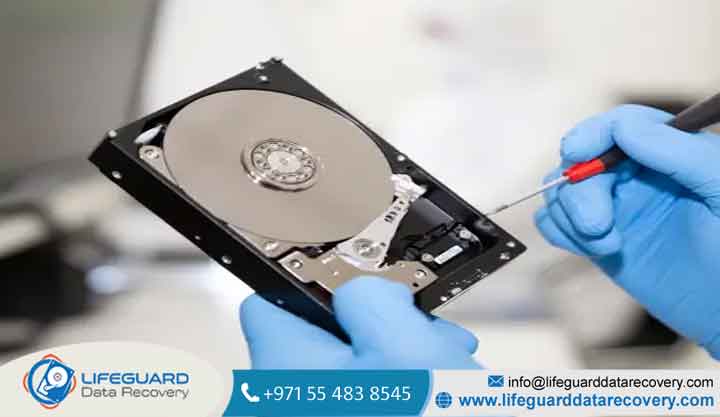
When an internal read-write head assembly collapses, it must be replaced inside a certified cleanroom. The engineering timeline here is entirely dependent on tracking down an exact matching “donor drive” from the same manufacturing batch. If the required donor part is available in local UAE inventories (Dubai or Abu Dhabi hubs),
repairs happen quickly. If a rare component must be flown in from international global supplier banks, tracking and shipping logistics can add additional days to your project.
How Long Does SSD Data Recovery Take in UAE?
Solid-state drive recovery behaves very differently from traditional hard drives. On average, an SSD data recovery UAE timeline ranges from business days Because solid-state drives (SSDs) lack moving parts, users assume they are faster to repair. The opposite is true. When an SSD controller chip degrades or experiences
firmware corruption, the data stored across its NAND flash memory chips becomes instantly scrambled. Engineers must use specialized hardware tools to bypass the controller, dump the raw data from individual chips, and manually reverse-engineer the manufacturer’s proprietary data-shuffling algorithms. This deep cryptographic and
algorithmic restructuring is highly labor-intensive.
Timeline Breakdown by Device and Failure Type
How Much Time Does Laptop Data Recovery Take in UAE?
For laptops that have suffered liquid damage, structural drops, or operating system crashes, expect a baseline turnaround of business days.
How Long Does External Hard Drive Recovery Take in UAE?
Portable external drives are highly susceptible to physical shock from accidental drops. If the drive dropped while spinning, the internal heads may have bent or mangled against the platters.
How Long Does RAID Server Data Recovery Take in UAE?
Enterprise systems, multi-drive NAS units, and production servers represent the most complex cases in the industry. A typical RAID server recovery UAE requires business days, though severe multi-drive failures can extend longer. The process requires stabilizing every individual drive in the array, creating sector-by-sector safety
clones, identifying the original stripe block sizes, and reconstructing the file system configuration virtually.
Safe Deep-Level Drive Imaging and Cloning (12 to 48 Hours)
The Golden Rule of Data Recovery: Engineers never work directly on your original failing drive, as it could die permanently at any second. Instead, they force the drive to generate a single bit-by-bit mirror clone onto healthy lab storage. If the original drive has extensive bad sectors, the cloning hardware must carefully skip, re-read, and baby the drive at low speeds to harvest data without causing a total head crash.
Prevention Tips to Minimize Business Downtime During a Crisis
While knowing the turnaround times helps you plan around an active emergency, the ultimate way to eliminate lab waiting periods is through resilient engineering design:
The 3-2-1 Backup Protocol: Maintain three independent copies of your data, stored on two distinct media types, with at least one copy secured entirely off-site in an automated cloud environment.
Stop Using the Media Immediately: If a drive exhibits clicking sounds or slow read speeds, kill the power. Forcing a dying drive to run will cause permanent platter scraping, turning a 2-day logical recovery into an irreversible physical data loss event.
Frequently Asked Questions (FAQ)
How long does deleted file recovery take in UAE?
Because the storage medium is physically pristine, engineers can run rapid partition scans to pull the data directly without needing cleanroom interventions.
Can I get my files back instantly if I bring the drive to the lab myself?
No. Even if you hand-deliver a drive, skipping mechanical diagnostics or rushing an imaging phase risks overheating the media and destroying the storage layer permanently. Immediate processing options are available via emergency tiers, but the physical cloning process still requires structural time.
Does the overall storage size of the drive change the time it takes?
Yes. A healthy 1TB drive can clone in a couple of hours under ideal conditions. A severely degraded 10TB drive with read-head complications may take days of constant monitoring on a specialized data extractor to completely read out
Does a longer recovery time mean a higher chance of success?
No. The time taken simply reflects the physical complexity of the extraction process, not the final outcome. A reliable lab will tell you exactly what can be recovered right after the initial diagnosis. Furthermore, standard industry practice among top UAE providers dictates a “No Data, No Charge” policy meaning if the lab takes a week but fails to extract the files, you do not pay for the recovery attempt.
Once the data is successfully recovered, how do I get it back?
Once extracted, the turnaround time for delivery depends on the size of the data and the method chosen:
Cloud Delivery: Small to medium amounts of data (documents, essential photos) are often uploaded to a secure cloud link within a few hours of completion.
Physical Media: Large chunks of data (hundreds of gigabytes or terabytes) will be loaded onto a new external hard drive or USB flash drive, which can be picked up or delivered via courier the next business day.