+971 50 634 3878 Sharjah, Dubai info@lifeguarddatarecovery.com
Best Server Recovery Company UAE
Modern business operations across the United Arab Emirates depend heavily on high-availability IT infrastructure. From global financial institutions in DIFC and ADGM to manufacturing hubs in JAFZA, an unhandled server outage leads to immediate operational disruption, lost revenue, and potential Lifeguard Data Recovery
compliance liabilities When critical database volumes, storage networks, or virtualized environments fail, fast and safe data retrieval becomes top priority. Finding the best server recovery company UAE enterprises can rely on requires understanding how complex server failures occur, what
immediate precautions to take, and how professional hardware recovery works under strict data protection frameworks This technical guide outlines the major failure vectors impacting enterprise storage systems, step-by-step emergency response workflows for systems administrators, and structural Lifeguard Data Recovery
benchmarks for evaluating specialized recovery providers across Dubai, Abu Dhabi, and the Northern Emirates.
Physical & Thermal Hardware Stress
Environmental factors in the Gulf region create unique physical challenges for enterprise hardware. High ambient temperatures and airborne dust can strain datacenter cooling systems, causing server chassis fans to run at maximum speeds and leading to thermal throttling.
Prolonged heat exposure accelerates mechanical degradation in High-RPM SAS/SATA magnetic drives. The mechanical components most vulnerable to heat fatigue and wear include:
Spindle Motor Bearings: Overheating degrades bearing lubricants, resulting in drive seizure or spindle lockup.
Actuator Arm Assemblies: Physical wear and micro-thermal expansion can cause the read/write heads to hover irregularly above magnetic platters.
Printed Circuit Boards (PCB): Transient power fluctuations during severe weather or grid strain can burn onboard controller chips or TVS diodes.
To prevent mechanical platter abrasion during physical repairs, technicians rely on specialized server hard drive recovery UAE facilities equipped with certified cleanroom environments.
Logical Corruption & RAID Controller Failures
Not all server crashes stem from mechanical physical failure. Logical corruption occurs within file system metadata, partition tables, or storage virtualization layers:
RAID Controller Microcode Crashes: A sudden power loss or memory write timeout can corrupt
the hardware RAID controller’s non-volatile RAM (NVRAM), wiping array metadata and rendering healthy member drives as “Unconfigured Good” or “Foreign.”
File System Metadata Damage: Abrupt shutdowns during active database writes can corrupt master file tables (MFT) in NTFS, allocation maps in ReFS, or superblock structures in EXT4/ZFS.
Degraded Array Double Parity Loss: In RAID 5 arrays running in a degraded state after a single drive failure, the elevated read stress during a rebuild operation frequently triggers a secondary read error (Unrecoverable Read Error – URE) on an aging drive, breaking the rebuild completely.
Complex multi-disk striping logical failures require specialized server RAID recovery UAE workflows to reconstruct stripe block sizes and parity orders at the binary level.
Human Error & Malicious Cyber Events
Human operational errors and cybersecurity breaches represent a significant percentage of server downtime events:
Accidental Volume Initialization: Inexperienced administrators re-initializing storage pools or forcefully clearing foreign RAID configurations during maintenance windows.
Improper Hot-Swapping: Inserting replacement drives into incorrect slots or removing active array members during dynamic rebuild phases.
Ransomware & Malicious Encryption: Advanced malware targeting hypervisor hosts (VMware ESXi, Hyper-V) to encrypt underlying storage LUNs and virtual hard disk files
Immediate Action Protocol: What to Do When a Server Fails
The first 15 minutes following a storage failure determine whether data remains fully recoverable or becomes permanently damaged. Improper automated or manual triage steps often cause irreversible data loss.
Step-by-Step Triage for IT Administrators
System Isolation
Stop all active write operations, suspend database services, and unmount unresponsive virtual storage LUNs to prevent dynamic index overwrites.
Diagnostic Capture
Document all physical hardware status indicators (flashing amber or red LEDs on storage bays), export controller event logs, and save active SMART telemetry tables.
Controlled Shutdown
Perform a graceful power-down of the host operating system to prevent continuous read head cycling. Label every physical drive clearly with its corresponding enclosure shelf and bay position before removal.
Media Preservation
Do not attempt destructive software rebuilds or disk checks. Package member drives securely in anti-static bags and transport them directly to a certified hardware recovery laboratory for forensic sector imaging.
How Professional Server Recovery Works: Technical Breakdown
Engineering-grade server recovery relies on non-destructive methodologies. Original client drives are never subjected to direct analytical writes or invasive software scans.
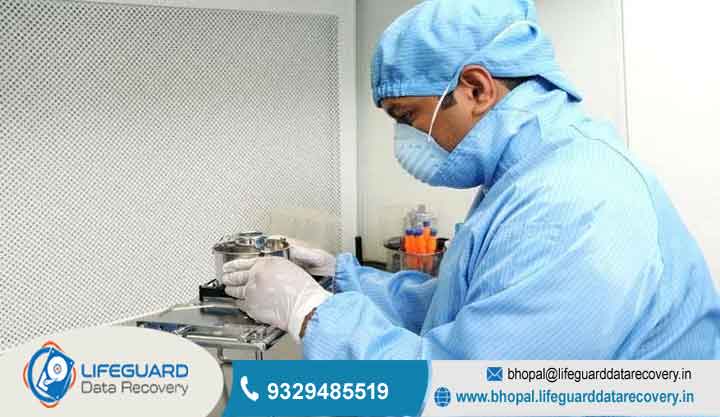
Hardware-Level Imaging & Class 100 Cleanroom Diagnostics
Physical drive recovery requires controlled, contamination-free laboratory conditions.
Internal hard drive read/write heads float just 3 to 10 nanometers above spinning magnetic platters. A single dust particle (typically 30–50 microns) entering an unsealed drive casing acts like an abrasive
block, permanently stripping magnetic storage layers from the platter surface.
Engineers operate within ISO Class 5 (Class 100) Cleanroom environments utilizing HEPA air filtration and horizontal laminar airflow to maintain air quality under 3,520 sub-micron particles per cubic
meter. Under these sterile conditions, technicians perform:
Micro-Surgical Head Assembly Replacement: Swapping damaged read/write head stacks using precise donor parts from identical firmware matches.
Spindle Motor & Platter Transfers: Extracting intact platter assemblies from seized motor casings and remounting them onto clean donor chassis.
Raw Hardware Imaging: Connecting repaired drives to hardware-level imaging systems (such as PC-3000) to create bit-for-bit sector clones while bypassing bad sectors, head read timeouts, and controller errors.
Enterprise-grade providers relying on dedicated lab equipment deliver reliable professional server recovery UAE services.
Virtual Assembly & File System Reconstruction
Once complete raw sector images are secured from all member drives, logical reconstruction follows a strict multi-step pipeline:
Member Drive Cloning: Securing 100% raw bitstream images from every accessible physical drive.
Hex Pattern Analysis: Engineers inspect raw hex patterns across image files to calculate parameters including block stripe size (e.g., 64KB, 128KB), block order direction (Left Synchronous, Right Asynchronous), and parity offset angles.
Virtual Array Emulation: The storage pool is re-assembled virtually using custom hex analysis algorithms, without writing data back to original drives.
File System Extraction: File system integrity is validated across virtual structures, extracting raw database stores, VMFS filesystems, or enterprise user directories for validation.
Complex array restoration mandates expert execution of RAID server recovery UAE protocols.
Evaluating Enterprise Storage Architectures
Storage recovery techniques vary depending on the underlying storage infrastructure and software stack.
Database Server Recovery (SQL, Oracle, Exchange)
When servers housing relational database engines fail mid-transaction, internal file pointers become disconnected:
Microsoft SQL Server : Corrupted page headers and broken allocation maps prevent the SQL engine from mounting data files. Recovery involves rebuilding torn pages, extracting tables directly from unmounted binaries, and validating system tables.
Oracle Database : Resolving sequence mismatch errors across redo log files and control files to restore data dictionary consistency.
Exchange Server : Fixing dirty shutdown states across Exchange database files by manually repairing transaction log sequences to allow mailbox extractions
Extracting intact database files requires advanced server data recovery UAE techniques.
Key Criteria for Selecting a Server Recovery Partner in the UAE
Selecting the right data recovery partner protects against secondary data damage and preserves organizational security compliance.
Technical Qualifications & Local Infrastructure
When evaluating server recovery vendors, request verification for these infrastructure benchmarks:
On-Site ISO 5 / Class 100 Cleanroom: Ensure mechanical drive repair takes place in a verified local cleanroom facility within the UAE rather than being shipped overseas.
Dedicated Enterprise Imaging Hardware: Verify the facility utilizes specialized forensic imaging equipment capable of adjusting read currents and head timing boundaries dynamically.
Evaluation Policy: Legitimate enterprise recovery vendors offer transparent initial diagnostics and clear target file listings prior to financial commitments.
Confirming these credentials helps businesses identify verified server recovery services UAE vendors.
Data Protection Laws & Security Compliance (UAE PDPL)
Handling sensitive enterprise data requires strict regulatory compliance under Federal Decree-Law No. 45 of 2021 regarding the Protection of Personal Data (UAE PDPL):
UAE PDPL Mandates: Vendors handling customer data, personal health records, or financial information must maintain compliant processing pipelines and strict encryption practices.
Non-Disclosure Agreements (NDAs): Enterprise recovery providers should execute legally binding NDAs protecting corporate intellectual property and end-user data privacy.
Chain-of-Custody Tracking: Clear logging protocols for hardware intake, media transfer, storage tracking, and certified physical drive destruction options upon request.
Working with a certified server data recovery company UAE keeps your organization fully compliant with regional data protection laws.
Proactive Server Protection & Disaster Recovery Best Practices
Relying on physical data recovery should remain an emergency last resort. Implementing structured resilience models mitigates hardware failure risks.
Organizations that invest in preventive measures reduce their exposure to unexpected business server data recovery UAE scenarios.
The 3-2-1-1-0 Backup Strategy
A robust, modern backup framework expands on traditional rules to safeguard against ransomware and physical disasters:
3 Unique Data Copies: Maintain primary operational data alongside two separate backup copies.
2 Different Media Types: Store backup data across distinct physical mediums (e.g., local NVMe/SAS storage pools and secondary offsite cloud/tape targets).
1 Offsite Location: Store at least one full backup copy in a secondary datacenter facility located in a separate geographic region.
1 Immutable Copy: Maintain an air-gapped or immutable S3 Object Lock copy that cannot be altered or deleted by unauthorized administrators or ransomware attacks.
0 Unverified Backups: Run automated restoration testing routines on backup sets to ensure zero mount or checksum errors.
Proactive Hardware & RAID Health Monitoring
Automated SMART & Predictive Telemetry: Configure centralized monitoring software (e.g., Zabbix, Nagios, PRTG) to report real-time drive reallocated sector counts and temperature variations.
Scheduled Consistency Checks: Run automated RAID parity consistency checks during off-peak operational windows to detect silently failing sectors before a drive drops offline.
Hot-Spare Drive Provisioning: Configure dedicated global or local hot-spare drives within every storage enclosure to initiate automatic array rebuilds immediately upon a single drive drop-out.
Datacenter Climate Control: Maintain server room ambient temperatures between 18°C and 22°C with controlled relative humidity (40–55%) to extend component longevity.
Frequently Asked Questions (FAQs)
How long does a server data recovery process usually take?
Standard enterprise server recovery timelines range between 24 and 72 hours for logical reconstructions or minor firmware fixes. Complex physical recoveries requiring Class 100 cleanroom part swaps, donor head sourcing, or extensive multi-drive imaging may take 3 to 5 business days. Emergency 24/7 priority services are typically available for mission-critical server downtime incidents.
Can data be recovered from a RAID array with multiple failed drives?
Yes. Recovery remains possible even if the number of drive failures exceeds the fault tolerance limit of the RAID configuration (e.g., two failed drives in a RAID 5, or three failed drives in a RAID 6). Specialized recovery engineers rebuild member drive images individually in a Class 100 cleanroom, then virtually align block stripe sequences to extract the data file system.
What is the cost range for enterprise server data recovery in the UAE?
Professional server data recovery costs depend on failure complexity, number of array member drives, physical hardware damage, and total lab time required rather than raw gigabyte size. Evaluation policies should provide a detailed diagnostic report with a fixed-fee quote prior to proceeding with any recovery operations.
Is it safe to run a RAID rebuild if one drive is emitting clicking sounds?
No. A clicking sound indicates a severe mechanical failure, such as damaged read/write heads or a failed actuator assembly. Running a software or controller-level RAID rebuild forces intense read operations across all drives, which will cause the clicking head to physically scratch the magnetic platters, leading to permanent data destruction.
How do data recovery providers ensure compliance with UAE data privacy laws?
Reputable data recovery companies enforce strict compliance with UAE PDPL (Federal Decree-Law No. 45 of 2021) by executing binding Non-Disclosure Agreements (NDAs), maintaining isolated offline laboratory networks, enforcing strict chain-of-custody protocols, and utilizing secure, encrypted verification media for recovered data delivery.